Buy | Submit | TRMGS1 | TRMGS2 | TRMGS3 | TRMGS4 |TRMGS Main | Heliograph Main
|
WHAT'S NEW?
The Complete Canal Priests Of Mars is now available!
The original publication of Canal Priests Of Mars cut slightly over a third of author Marcus L. Rowland's manuscript to fit GDW's adventure format.
The Complete Canal Priests Of Mars restores the cut material, features all new artwork by Paul Daly, and adds many useful player handouts. Enjoy the "author's cut" of a classic Space 1889 adventure, or experience it for the first time!
See our Buy It! page for more information!
Old news is still available on the News Page.
|
Theater of the Bizarre
Gatling Guns and Camels
by Charles F. Hawkins
Reprinted from the American Sentinel
Ever since the first projectile was hurled from a sling, warriors
have sought ways to leverage their firepower with multiple-firing
weapons. The advent of gunpowder in Europe around the 15th century and
improved metal-working skills of the time combined to further the quest
of militaries to seek means of delivering rapid and repeated shots
against an enemy without increasing the overall number of firearms.
Although some interesting examples came about the Puckle Gun
in England in the early 1700s; the French Mitrailleuse, with its 37 rifled barrels
in the mid-19th century it remained for an inventor of agricultural machines
to bring about the first widely used quick-firing weapon.
The most successful rapid-fire weapon of
the mid-19th century was the handiwork of Dr.
Richard Jordan Gatling (1818-1903), a South Carolina inventor
less remembered for his agricultural inventions than his
200-shots-per-minute Gatling Gun. Patented in November 1862, the gun fired paper cartridges, later replaced
by copper rim-fire cartridges, sequentially from six musket-caliber
barrels which were rotated by a hand crank that also fired the weapon.
Feeding ammunition was accomplished by a gravity-feed mechanism at first
and later by a positive-feed magazine in the 1890s.
After numerous modifications, the U. S. Army ordered 100 of
the weapons in 1866, and within twenty years, Gatling's "labor saving
device for warfare" saw service in nearly all the militaries that could
afford it, and in most regions of the world.
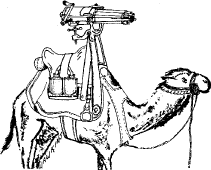
Indeed, one place the Gatling Gun saw service was in Egypt in
the 1870s, where British troopers and their Egyptian allies mounted
the weapon on camel saddles. There is scant information on whether
such an arrangement was actually used in battle; the Gatling's life cycle
was cut short by the invention by Hiram Maxim of the first
fully-automatic machine gun in the mid-1880s. Still, one is left to ponder the
circumstances of the camel-mounted weapon and the effect it might have
had on foe, friend and camel alike.
Posted Monday, 04-May-2009 19:50:04 EDT
Return to Main Page
Comments to webmaster@heliograph.com
The material on this page is Copyright 2000 under the author or artist's name unless noted otherwise, and cannot be used without permission. This presentation Copyright 2000 by Heliograph, Inc. Space:1889 is a registered trademark of Frank Chadwick, all rights reserved, and is used with his permission. Most other game, movie, or book names may be trademarks of their respective holders, and use of a trademark at this site should not be construed as implying the sponsorship of the trademark holder, nor, conversely, should use of the name of any product without mention of trademark status be construed as a challenge to such status. Heck no! We love those guys.