Buy | Submit | TRMGS1 | TRMGS2 | TRMGS3 | TRMGS4 |TRMGS Main | Heliograph Main
|
WHAT'S NEW?
The Complete Canal Priests Of Mars is now available!
The original publication of Canal Priests Of Mars cut slightly over a third of author Marcus L. Rowland's manuscript to fit GDW's adventure format.
The Complete Canal Priests Of Mars restores the cut material, features all new artwork by Paul Daly, and adds many useful player handouts. Enjoy the "author's cut" of a classic Space 1889 adventure, or experience it for the first time!
See our Buy It! page for more information!
Old news is still available on the News Page.
|
'Tisn't Just Virtue That Protects A Lady!
Arming the Adventuress
by J. Ruth Dempsey
"On August 8, 1840, after scalping their way across south
Texas, Buffalo Hump and his 500 Comanche Warriors galloped
into Linnville, a port on Lavaca Bay. One of their first victims
was Major Watts, the customs collector. Turning to the attractive
Mrs. Watts, several warriors tore off her dress, then tackled her
corset. After a lengthy struggle with its multiple hooks and
crisscrossed laces, the men abandoned the assault, but not Mrs.
Watts. With her in tow, they advanced on the town's center. It was
empty. The residents had seized the opportunity to flee in their boats
to the middle of Lavaca Bay while the Comanches were
fighting their losing battle with the corset.
"After looting a warehouse and setting fire to houses,
the Indians turned to their last piece of business in town. Tying
the still-corseted Mrs. Watts to a tree, they administered the coup
de grace an arrow shot into her chest and left her for dead.
"When the Texas Rangers following in Buffalo Hump's
tracks found Mrs. Watts on August 9, she was not dead, only
sunburned. The arrow had struck a tough whalebone stay, thus losing
so much force that the injury to Mrs. Watts was minor. No one
could doubt that this corset was made of the right stuff."
"The Secret Weapon of Mrs. Watts,"
Time-Life Books Library of Curious and Unusual Facts: A World of
Luck, 1991, pp. 84-5.
I have nothing but the highest respect for the
Space: 1889 sourcebook, yet, I confess to being a tad disappointed in the list
of various weaponry and armaments. While providing sufficient choices and
statistics for the manly adventurer, the book fails to mention and provide
statistics for two purely "feminine" articles:
the hatpin and the corset.
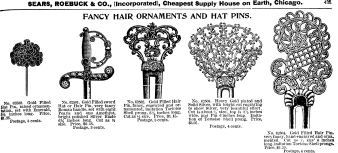
From the 1897 Sears, Roebuck & Co. Catalog
The Hatpin
The hatpin at this time could be a very effective weapon, ranging in
length from 9 to 15 inches of solid steel with a razor-sharp point. It was designed
to penetrate the various layers of ribbons, cloth, straw, feathers, flowers and
whatnots that composed the hat and anchor the construction to the Victorian
lady's "bun" or "Gibson girl" hairstyle.
Usually 3 to 4 were used to keep the hat in place. In a sticky situation, a lady would
sacrifice her dignity and her hat to utilize the pin as a stabbing weapon. The most
famous example of this is the woman known as "Typhoid Mary:" upon her
arrest she used her hatpin to hold off three policemen until her subdual.
Using the hatpin falls under Close Combat (edged weapon) in
Space: 1889, Fencing in Call of
Cthulhu. Damage is 1 for the former system, 1d4 for the
latter (impale is possible). Base price is 5p, more for ornate or decorated versions.
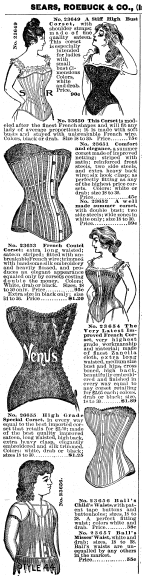
From the 1897 Sears, Roebuck & Co. Catalog
The Corset
While much can be said against the corset as an article of bodily
torture, there is a great deal to be said for its armor value. The
corset consisted of vertical "stays" of either steel or
whalebone sandwiched between layers of light-weight sail canvas, covered with
either cotton (the "maid's corset"), silk, or
satin (the "Aristocrat's corset"). Metal
hooks secured the corset's inner layer while the outer layer was laced with sturdy
twine. The corset hooked and laced either in the front or the back;
servant-class women tended to wear the front-lace
corset because they could get into it faster, while "milady" used her maid
to lace her up the back.
True, the corset decreases the wearer's ability to move quickly,
but no more so than your basic chain mail shirt. Besides, "Ladies
never hurry." As to the effectiveness of its armor value (not to mention
its nuisance factor), see the extract printed at the beginning of this article.
Treat the corset as armor factor 1 against hand weapons and
arrows only for Space: 1889. Prices start at around £1 for a front-lace
cotton model, with elaborate satin back-lace models going for £30 and up.
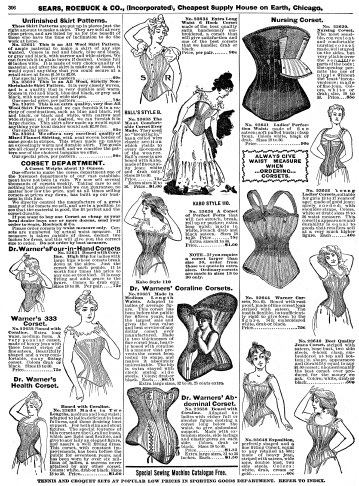
From the 1897 Sears, Roebuck & Co. Catalog
Posted Monday, 04-May-2009 19:49:56 EDT
Return to Main Page
Comments to webmaster@heliograph.com
The material on this page is Copyright 2000 under the author or artist's name unless noted otherwise, and cannot be used without permission. This presentation Copyright 2000 by Heliograph, Inc. Space:1889 is a registered trademark of Frank Chadwick, all rights reserved, and is used with his permission. Most other game, movie, or book names may be trademarks of their respective holders, and use of a trademark at this site should not be construed as implying the sponsorship of the trademark holder, nor, conversely, should use of the name of any product without mention of trademark status be construed as a challenge to such status. Heck no! We love those guys.